Archive for the 'Ancient Wonders' Category

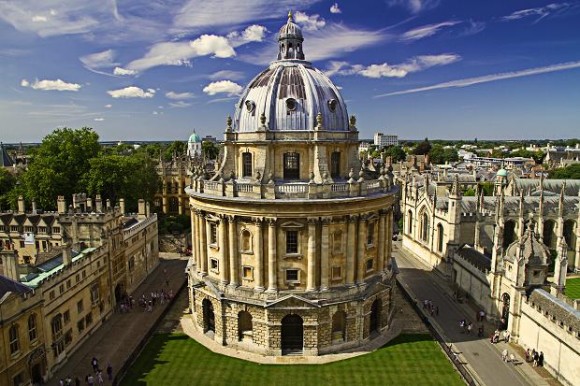
The Bodleian Library: Six reasons it’s the most magical.

Here’s the place to build brick by brick and book by book in your mind’s eye for those moments when you need to curl up in the most magical library on earth…Or you could hop on a plane!
 

1435008521-1435008521_goodreads_misc


6 Reasons to Add the Bodleian Library to Your Book Bucket List
Posted by Hayley Igarashi (Goodreads)


“If “books are a uniquely portable magic,” then libraries must be one of the most magical places on earth (and librarians must be magicians). Oxford University’s Bodleian Library certainly looks the part. This historical institution—and part-time Hogwarts stand-in—is a must-see for any traveling book worm. If it isn’t on your book bucket list already, we think we can change your mind.


Reason #1: It has over 11 million printed items.


Not to shame your local library, but we’re betting your usual book haunts can’t quite compare to Bodleian’s veritable army of tomes. Among the 11 million items to browse are a rare copy of Shakespeare’s First Folio, unbound and unrestored, along with the largest collection of pre-1500 printed books in any university library in the world….”


For the rest, click here.

Share
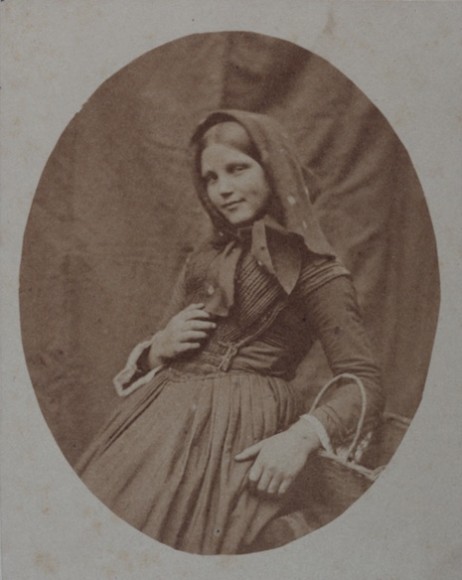
Portraits of madwomen

Each one of them could be a character in their own tragic novel…


009patimenhos19th009


(Dangerous Minds)


“Among the early pioneers of photography in the 1800s was a middle-aged English doctor called Hugh Welch Diamond, who believed photography could be used in the diagnosis and treatment of the mentally ill. Diamond first established his medical career with a private practice in Soho, London, before specializing in psychiatry and becoming Resident Superintendent of the Female Department at the Surrey County Lunatic Asylum in 1848—a position he held until 1858. Diamond was an early adopter of photography, taking his first portraits just three months after Henry Fox Talbot licensed his “salt print” process for producing “photogenic drawings.” As a follower of “physiognomics”—a popular science based on the theory that disease (and character) could be discerned from an individual’s features or physiognomy—Diamond believed photography could be used as a curative therapy…”


For the rest, and an amazing gallery of images, click here.


Share

The Nocturnal Picaresque

A “noctuary” is  “an account of what passes at night” — this lovely little word opens the door to so many mysterious musings…


18419684751_4018f8a38b_h


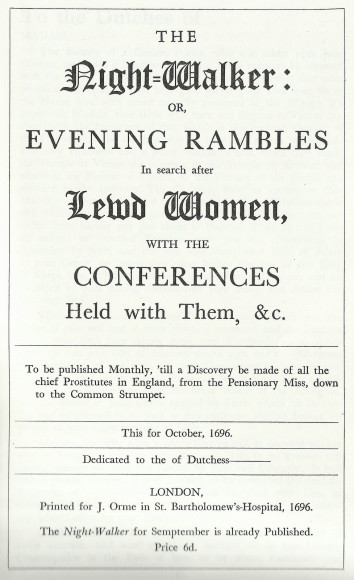
The Nightwalker and the Nocturnal Picaresque


The introduction of street lighting to 17th-century London saw an explosion of nocturnal activity in the capital, most of it centering around the selling of sex. Matthew Beaumont explores how some writers, with the intention of condemning these nefarious goings-on, took to the city’s streets after dark, and in the process gave birth to a peculiar new literary genre.


“At the end of the seventeenth century a new literary genre or subgenre emerged in England, one that might be characterized as the nocturnal picaresque. Its authors, who were moralists or satirists or social tourists, or all of these at the same time, and who were almost invariably male, purported to recount their episodic adventures as pedestrians patrolling the streets of the metropolis at night.


These narratives, which often provided detailed portraits of particular places, especially ones with corrupt reputations, also paid close attention to the precise times when more or less nefarious activities unfolded in the streets. As distinct from diaries, they were noctuaries (in his Dictionary of the English Language [1755], Samuel Johnson defined a “noctuary” simply as “an account of what passes at night”).1 These apparently unmediated, more or less diaristic accounts of what happened during the course of the night on the street embodied either a tragic or a comic parable of the city, depending on whether their authors intended to celebrate its nightlife or condemn it as satanic…”


For the rest, click here to go to The Public Domain Review.

Share

« Previous PageNext Page »