Archive for the 'Oddities' Category

A Beautiful, Beautiful Musical Rabbit Hole…

mg_6391


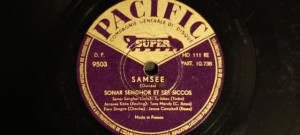
A music lover’s and a sensualist’s dream – a collection of rare and universally gorgeous old 78s…


Ceints de Bakélite: Vintage 78 rpm records and other musical curiosities collected around the world

Here.


P.S. Particularly This One (A Mysterious Japanese Waltz!), And This One too (The Golden Age of Soviet Jazz!)…Well, actually, it just goes on and on! We hope you have a few hours to spend with some good headphones.

Share

Utriusque Cosmi: The History of the Two Worlds…

Incredibly intricate images of the divine and the universe in cosmologies of long ago…


Robert Fludd and His Images of The Divine (The Public Domain Review)
 

6130074253_c153f55089_o


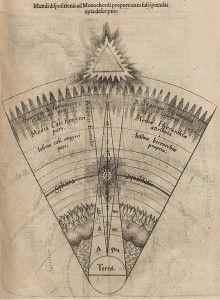
Between 1617 and 1621 the English physician and polymath Robert Fludd published his masterwork Utriusque Cosmi, a book split into two volumes and packed with over 60 intricate engravings. Urszula Szulakowska explores the philosophical and theological ideas behind the extraordinary images found in the second part of the work.


“Robert Fludd was a respected English physician (of Welsh origins) employed at the court of King James I of England. He was a prolific writer of vast, multi-volume encyclopaedias in which he discussed a universal range of topics from magical practices such as alchemy, astrology, kabbalism and fortune-telling, to radical theological thinking concerning the inter-relation of God with the natural and human worlds. However, he also proudly displayed his grasp of practical knowledge, such as mechanics, architecture, military fortifications, armaments, military manoeuvres, hydrology, musical theory and musical instruments, mathematics, geometry, optics and the art of drawing, as well as chemistry and medicine. Fludd used the common metaphor for the arts as being the “ape of Nature,” a microcosmic form of the manner in which the universe itself functioned.


Fludd’s most famous work is the History of the Two Worlds (Utriusque Cosmi … Historia, 1617-21) published in five volumes by Theodore de Bry in Oppenheim. The two worlds under discussion are those of the Microcosm of human life on earth and the Macrocosm of the universe (which included the spiritual realm of the Divine).


Fludd himself was a staunch member of the Anglican Church. He was educated in the medical profession at St. John’s College in Oxford. In 1598-1604/ 5 he set out for an extended period of travel on the continent. He spent a winter with some Jesuits, a Roman Catholic order deeply opposed to Protestantism who, nevertheless, tutored Fludd on magical practices…”


Read the rest, here.


Share
The terrifying Great Norway Serpent…


…a legacy of sea monsters.


Olaus Magnus’s Sea Serpent (The Public Domain Review)


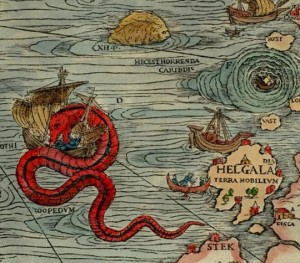
The terrifying Great Norway Serpent, or Sea Orm, is the most famous of the many influential sea monsters depicted and described by 16th-century ecclesiastic, cartographer, and historian Olaus Magnus. Joseph Nigg, author of Sea Monsters, explores the iconic and literary legacy of the controversial serpent from its beginnings in the medieval imagination to modern cryptozoology.


The original Sea Orm. Detail from Magnus’s Carta Marina of 1539 showing a bright red monster encircling a ship off the coast of Norway with maelstrom whirling away to the right – Source.

The original Sea Orm. Detail from Magnus’s Carta Marina of 1539 showing a bright red monster encircling a ship off the coast of Norway with maelstrom whirling away to the right.


“In his comprehensive study, The Great Sea-Serpent: An Historical and Critical Treatise (1892), Dutch zoologist Antoon Cornelius Oudemans lists more than three hundred references to the notorious sea monster in his chronological “Literature on the Subject.” The first ten of those, 1555-1665, cites Olaus Magnus’s sea serpent: editions of Olaus’s Historia de gentibus septentrionalibus (“History of the Northern Peoples”) and natural histories of Conrad Gesner, Ulisse Aldrovandi, Edward Topsell, and John Jonston. The list establishes Olaus’s serpentine monster as the major ancestral source of sea serpent lore from the sixteenth century to widespread sightings of such creatures in Oudemans’s own time. It is the basis for illustration and discussion of the creature in marine studies and popular fantasy up to the present, five hundred years after Olaus created it…


Read more here.

Share

« Previous PageNext Page »