Archive for the 'Religion & Spirituality' Category

What Vampire Graves Tell Us…

Who doesn’t enjoy a morbid love of vampires? And who doesn’t love the history of vampires even more?
 

4b350f9c8


What Vampire Graves Tell Us About Ancient Superstitions


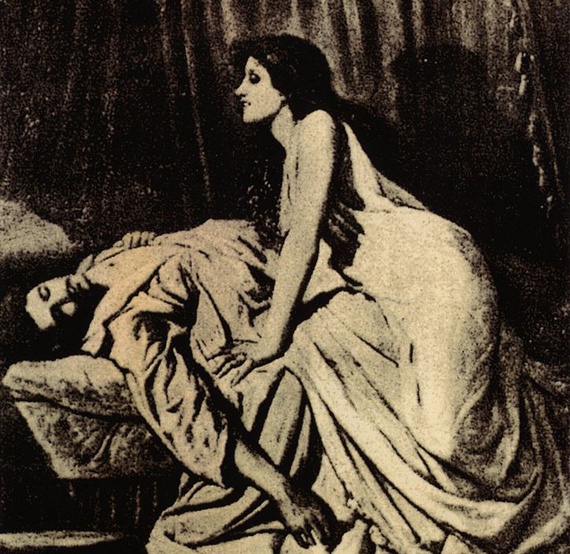
Hundreds of years ago, ignorance about decomposition and disease sparked fears that the dead returned to drink the blood of the living.


“In 1846, a man named Horace Ray died of tuberculosis in Griswold, Connecticut. Within the next six years, two of his grown sons died of the same disease. When yet another son fell ill two years later, Ray’s family and friends could think of only one explanation: The dead sons were somehow feeding on and sickening the living one—from the afterlife. In an effort to keep the remaining son from getting even worse, they exhumed the dead sons’ bodies and burned them.


This wasn’t an isolated incident. In 1874, a Rhode Island man named William Rose dug up his own daughter’s body and burned her heart, and in 1875 a victim of “consumption,” as TB was called then, had her lungs burned posthumously for good measure.


This practice of digging up, burning, or otherwise attempting to restrain the deceased was a widespread practice in many Western countries until the early 20th century, and it was intended to prevent what people at the time thought of as vampires: Dead victims of disease that literally sucked the life out of the living from beyond the grave.


We now imagine vampires as blood-drinking, cloaked Counts—or possibly sparkly, sexy teenagers—but throughout history everyone from the Ancient Greeks, to the Eastern Europeans, to 19th-century Americans saw them as disease victims (and sometimes simply dead miscreants) who could prey on the living from the Great Beyond…”


For the rest, go here, to The Atlantic.


Share
New Scientific Study of Near Death Experience…


We have a close friend who experienced an NDE — his account is so sincere and so vivid, there is no doubt in our minds that this phenomenon exists…


First hint of ‘life after death’ in biggest ever scientific study

By Sarah Knapton, Science Correspondent


Southampton University scientists have found evidence that awareness can continue for at least several minutes after clinical death which was previously thought impossible


“Death is a depressingly inevitable consequence of life, but now scientists believe they may have found some light at the end of the tunnel.


The largest ever medical study into near-death and out-of-body experiences has discovered that some awareness may continue even after the brain has shut down completely.


It is a controversial subject which has, until recently, been treated with widespread scepticism.


But scientists at the University of Southampton have spent four years examining more than 2,000 people who suffered cardiac arrests at 15 hospitals in the UK, US and Austria.


And they found that nearly 40 per cent of people who survived described some kind of ‘awareness’ during the time when they were clinically dead before their hearts were restarted…”


Click here for the rest.

Share

Mushroom Mandrakes?

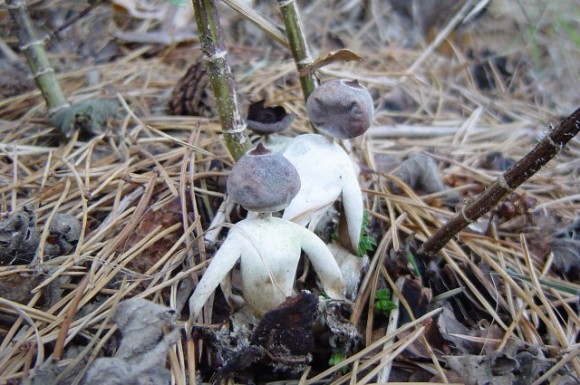
Don’t they remind you of little witch’s mandrakes?


Human-Shaped Species Of Mushroom Discovered In UK

by Stephen Luntz


“It’s amazing what is right under our noses without being noticed. A species of mushroom that can look remarkably like stick-figure humans has been discovered, and far from being in some sparsely inhabited jungle, they were found by a road in England


Jonathan Revett has a hobby for collecting mushrooms, which he tracks on his fenfungi website. In 2000, he noticed some specimens with an unusual shape by a roadside in Norfolk. While Revett recognized the specimens as being a type of Earthstar mushroom, he doubted they were Rayed Earthstars, the most similar species.


It took many years after his sending samples to be checked, but Revett’s hunch has been confirmed. This is a new species, named Geastrum britannicum, that was identified in Persoonia as part of a DNA analysis to establish the relationships between the variety of related Earthstar species.


The paper identifies seven new species, but G. britannicum’s distinctive shape makes it stand out (sorry, not sorry) from the common mushroom herd. In Field Mycology, the authors report that G. britannicum is “surprisingly common,” having been found at 15 locations across southern Britain…”


For the rest, click here.


Share

« Previous PageNext Page »