Archive for the 'Religion & Spirituality' Category

England’s biggest peacetime witch trial: The Trial of The Lancashire Witches

It was England’s biggest peacetime witch trial: The Trial of The Lancashire Witches. And it was brutal…


Does it have relevance today?
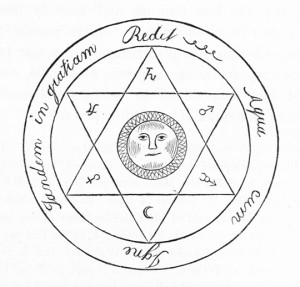
 

Illustration from James Crossley’s introduction to Pott’s Discovery of witches in the County of Lancaster (1845) reprinted from the original edition of 1613. - See more at: http://publicdomainreview.org/2012/08/22/the-lancashire-witches-1612-2012/#sthash.zZSj2BFu.dpuf

Illustration from James Crossley’s introduction to Pott’s Discovery of witches in the County of Lancaster (1845) reprinted from the original edition of 1613.


The Lancashire Witches 1612-2012 (The Public Domain Review)


Not long after ten Lancashire residents were found guilty of witchcraft and hung in August 1612, the official proceedings of the trial were published by the clerk of the court Thomas Potts in his The Wonderfull Discoverie of Witches in the Countie of Lancaster. Four hundred years on, Robert Poole reflects on England’s biggest witch trial and how it still has relevance today.


Four hundred years ago, in 1612, the north-west of England was the scene of England’s biggest peacetime witch trial: the trial of the Lancashire witches. Twenty people, mostly from the Pendle area of Lancashire, were imprisoned in the castle as witches. Ten were hanged, one died in gaol, one was sentenced to stand in the pillory, and eight were acquitted. The 2012 anniversary sees a small flood of commemorative events, including works of fiction by Blake Morrison, Carol Ann Duffy and Jeanette Winterson. How did this witch trial come about, and what accounts for its enduring fame?


We know so much about the Lancashire Witches because the trial was recorded in unique detail by the clerk of the court, Thomas Potts, who published his account soon afterwards as The Wonderful Discovery of Witches in the County of Lancaster…


See the rest here.


Share

New Tests Show The Gospel of Mary Magdalene Is Indeed Ancient…

mary-magdalene


The Gospel of Mary Magdalene is deeply controversial, and as much as the more stubborn religious scholars would love to reject it, the fact is it was written in ancient times, and therefore likely to be closer to a true representation of the historical Jesus than the bible itself (which was edited and reworked countless times in the ancient world and its content subjected to both political and religious pressures).


So, despite the debate of whether or not Jesus was married, what were the roles of women in the early church? If this gospel is to be believed, women were much more influential than we thought…


Tests Show ‘Gospel of Jesus’s Wife’ Is Ancient (NPR)


“Harvard University professor Karen King says this fragment of papyrus, which she unveiled last year, is the only existing ancient text quoting Jesus explicitly referring to having a wife.


New tests show that the fragment of papyrus called “Gospel of Jesus’s Wife” is actually from ancient times. The results of a carbon dating test show that it probably dates to eighth-century Egypt.


The discovery of the fragment, which includes the words “Jesus said to them, ‘My wife…’” was announced to the world a little more than a year ago by Karen L. King, a professor of history at Harvard’s School of Divinity.


The gospel immediately sparked heated debate and drew immediate dismissals from some because the gospel refers to Jesus being married.


King joins Here & Now’s Robin Young to discuss the implications of the latest tests. She says there should not be a debate over whether or not the historical Jesus was married, rather the role of wives, mothers and sexuality in Christianity…”


Listen to the NPR radio presentation here.


Share

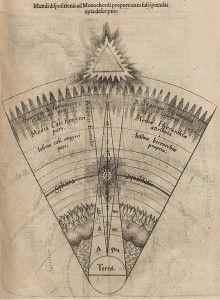
Utriusque Cosmi: The History of the Two Worlds…

Incredibly intricate images of the divine and the universe in cosmologies of long ago…


Robert Fludd and His Images of The Divine (The Public Domain Review)


6130074253_c153f55089_o


Between 1617 and 1621 the English physician and polymath Robert Fludd published his masterwork Utriusque Cosmi, a book split into two volumes and packed with over 60 intricate engravings. Urszula Szulakowska explores the philosophical and theological ideas behind the extraordinary images found in the second part of the work.


“Robert Fludd was a respected English physician (of Welsh origins) employed at the court of King James I of England. He was a prolific writer of vast, multi-volume encyclopaedias in which he discussed a universal range of topics from magical practices such as alchemy, astrology, kabbalism and fortune-telling, to radical theological thinking concerning the inter-relation of God with the natural and human worlds. However, he also proudly displayed his grasp of practical knowledge, such as mechanics, architecture, military fortifications, armaments, military manoeuvres, hydrology, musical theory and musical instruments, mathematics, geometry, optics and the art of drawing, as well as chemistry and medicine. Fludd used the common metaphor for the arts as being the “ape of Nature,” a microcosmic form of the manner in which the universe itself functioned.


Fludd’s most famous work is the History of the Two Worlds (Utriusque Cosmi … Historia, 1617-21) published in five volumes by Theodore de Bry in Oppenheim. The two worlds under discussion are those of the Microcosm of human life on earth and the Macrocosm of the universe (which included the spiritual realm of the Divine).


Fludd himself was a staunch member of the Anglican Church. He was educated in the medical profession at St. John’s College in Oxford. In 1598-1604/ 5 he set out for an extended period of travel on the continent. He spent a winter with some Jesuits, a Roman Catholic order deeply opposed to Protestantism who, nevertheless, tutored Fludd on magical practices…”


Read the rest, here.


Share

« Previous PageNext Page »