Archive for the 'Religion & Spirituality' Category

A Brief History of the Apocalypse

It begins here, but where does it end? (Click here for the complete “history”) –


ca. 2800 BC According to Isaac Asimov’s Book of Facts (1979), an Assyrian clay tablet dating to approximately 2800 BC was unearthed bearing the words “Our earth is degenerate in these latter days. There are signs that the world is speedily coming to an end. Bribery and corruption are common.” This is one of the earliest examples of the perception of moral decay in society being interpreted as a sign of the imminent end.
634 BC Apocalyptic thinking gripped many ancient cultures, including the Romans. Early in Rome’s history, many Romans feared that the city would be destroyed in the 120th year of its founding. There was a myth that 12 eagles had revealed to Romulus a mystical number representing the lifetime of Rome, and some early Romans hypothesized that each eagle represented 10 years. The Roman calendar was counted from the founding of Rome, 1 AUC (ab urbe condita) being 753 BC. Thus 120 AUC is 634 BC. (Thompson p.19)
Share

Ancient “Bed Burial” Enlightens Scholars


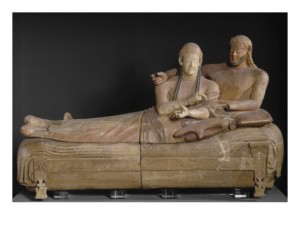
Archeologists discover seventh-century teenager buried in bed

(thespec.com)


LONDON Archeologists excavating near Cambridge have stumbled upon a rare and mysterious find: The skeleton of a seventh-century teenager buried in an ornamental bed along with a gold-and-garnet cross, an iron knife and a purse full of glass beads.


Experts say the grave is an example of an unusual Anglo-Saxon funerary practice of which very little is known. Just over a dozen of these “bed burials” have been found in Britain, and it’s one of only two in which a pectoral cross — meant to be worn over the chest — has been discovered.


One archeologist said the burial opened a window into the transitional period when the pagan Anglo-Saxons were gradually adopting Christianity, a few centuries after Romans introduced it to the native Britons.


“We are right at the brink of the coming of Christianity back to England,” said Alison Dickens, the manager of Cambridge University’s Archeological Unit. “What we have here is a very early adopter.”


The grave, dated between AD 650 and 680, was discovered about a year ago in a corner of Trumpington Meadows, a rural area just outside Cambridge that is slated for development.


Dickens said the teen’s grave was interesting because it had a mix of traditional grave goods…


For the complete article click here.


Share

Party at Gobekli Tepe

I would love to go back in time to visit Gobekli Tepe…


‘World’s oldest temple’ was a happenin’ place

Ancient blades of volcanic rock hint that people came from far and wide 11,000 years ago


Gobekli Tepe is in southern Turkey near the modern-day city of Urfa. It contains at least 20 stone rings (circles within a circle) that date back more than 11,000 years. T-shaped limestone blocks line the circles and reliefs are carved on them. Long ago, people would fill in the outer circle with debris before building a new circle within.


By Owen Jarus (msnbc.com)


Ancient blades made of volcanic rock that were discovered at what may be the world’s oldest temple suggest that the site in Turkey was the hub of a pilgrimage that attracted a cosmopolitan group of people some 11,000 years ago.


The researchers matched up about 130 of the blades, which would have been used as tools, with their source volcanoes, finding people would have come from far and wide to congregate at the ancient temple site, Gobekli Tepe, in southern Turkey. The blades are made of obsidian, a volcanic glass rich with silica, which forms when lava cools quickly.


The research was presented in February at the 7th International Conference on the Chipped and Ground Stone Industries of the Pre-Pottery Neolithic in Barcelona, Spain. [ Photos of Gobekli Tepe ]…


For the complete article click here.

Share

« Previous PageNext Page »