Archive for the 'Uncategorized' Category

The Senegambian stone circles…

I bet you haven’t heard of the Senegambian stone circles.


So, what are they?


The Senegambian Stone Circles are various stone circles that are spread over thousands of miles in both Senegal and the Gambia.


It seems that every continent has its ancient secrets. No one is sure exactly how old these things are…


Senegambian stone circles


From Wikipedia, the free encyclopedia


“The stones were erected around the eighth century on top of earlier graves. The ten to twenty-four stones in each circle vary in size up to ten-ton stones, from 1 to 2.5 metres high and are generally of laterite. The stones mark burials and were erected before the twelfth century. There are around 1,000 stone circles, the biggest concentration being more than 1,000 stones in fifty-two circles at Djalloumbéré and those around the village of Wassu, which has a museum devoted to them. One notable circle is actually a V formation. Traditionally, for unknown reasons, people leave small rocks on the stones. The use to which the stones were put is not clear but recent excavation work (2006), reported by the National Geographic Society, suggests a funerary purpose given the large number of human remains found at the sites. Archaeologists at the site are pursuing the theory that different parts of a body were buried at different sites and at different times…” (The rest is here.)


For more info on these mysterious circles, click here.

Share
The Secret History of the Dixie Cup

What was it like before we had single serving receptacles at our disposal as simple as the common paper cup? Such objects are taken for granted to the point where they seem invisible, and yet the significance of such objects is legion…


The Unnatural History of the Dixie Cup


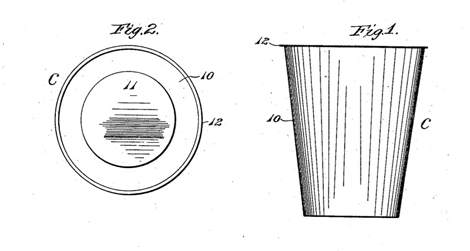
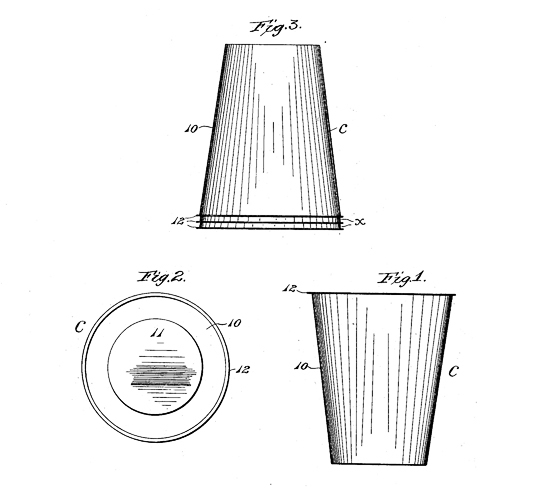
The Dixie Cup, the Kleenex of paper cups, the ubiquitous, single-serving, individual drinking vessel, was never meant to be shared. The paper cups were not built to last. Drink. Toss. Repeat.


Their story starts with a Boston inventor named Lawrence Luellen, who crafted a two-piece cup made out of a blank of paper. He joined the American Water Supply Company, the brainchild of a Kansas-born Harvard dropout named Hugh Moore. The two began dispensing individual servings of water for a penny—one cent for a five-ounce cup from a tall, clumsy porcelain water cooler.


Soon they were the Individual Drinking Cup Company of New York and had renamed their sole product the Health Kup, a life-saving drinking technology that could help prevent the transmission of communicable disease and aid the campaign to do away with free water offered at communal cups, “tin dippers,” found in public buildings and railway stations. Make no mistake, because of this scourge, one biologist reported in a 1908 article, there was “Death in School Drinking Cups.”…


For the complete article click here to go to Smithsonian.com.

Share

Turing’s Sentient Mind

The man called Alan Turing was certainly a genius: He foresaw the power and influence of computers – as well as how they would work. He also lived a life of persecution for being a homosexual, he was eventually arrested and forced into chemical “castration”. They say he committed suicide by lacing an apple with cyanide (his favorite story was Snow White and The Seven Dwarves.)


But the most interesting thing about Turing is that he was the first person to ask the question: Will machines someday be able to think like humans? And if so, will they be victims of prejudice too?


The Turing Problem

from RadioLab


“100 years ago this year, the man who first conceived of the computer age was born. His name was Alan Turing. He was also a math genius, a hero of World War II and he is widely considered to be the father of artificial intelligence. But the world wasn’t kind to Alan Turing. In 1952, he was arrested and convicted under a British law that prohibited “acts of gross indecency between men, in public or private.”


In 1936, a young Alan Turing devised a machine that would ultimately change the world. You’re staring at it right now–except Turing’s “universal machine” was much, much simpler and totally imaginary. Nonetheless, he proved that with just a few simple ingredients, the machine could compute any mathematical problem that a human could compute….”


Listen to the complete story below –


Share

« Previous PageNext Page »