Poison Garments of the Victorian Age

…But would you have worn them anyway?
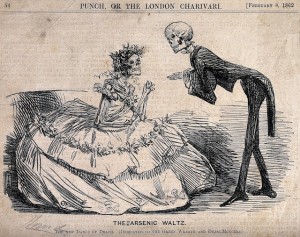
 

V0042226 Two skeletons dressed as lady and gentleman. Etching, 1862.

Two skeletons dressed as lady and gentleman in “the Arsenic Waltz,” Etching (1862) (courtesy Wellcome Library, London)


Fatal Victorian Fashion and the Allure of the Poison Garment


by Allison Meier


“Staying stylish in the Victorian period could be a dance of death. While industrialization and mass production made more beautiful fashions widely available, the green dresses were dyed with arsenic-based pigments, the mercury necessary to make shiny beaver top hats drove the hatters insane, and all that tulle and cinched corsets contorting women into airy nymphs would not infrequently cause them to tumble into gas lamps and go up in flames.


Opened this week at the Bata Shoe Museum in Toronto, Fashion Victims: The Pleasures and Perils of Dress in the 19th Century explores the dangers of style not just for the wearers, but for the people who made the clothing as well. The exhibition of over 90 artifacts was organized by Bata Shoe Museum Senior Curator Elizabeth Semmelhack, and Alison Matthews David, an associate professor at the School of Fashion at Ryerson University who is publishing a book next year focusing on deadly fashion. Together the curators explored medical archives and collections in France and England, and delved into the museums’ extensive assortment of 19th century shoes and private collections searching for examples of the “poison garment,” hauling green shoes and shoeboxes to a physics lab to test for their lethal secrets…”


For the complete piece click here.

Share

The Hum

Have you heard of the Hum? Or… have you actually HEARD the Hum?


the-hum


A Mysterious Sound Is Driving People Insane — And Nobody Knows What’s Causing It

by Jared Keller


Dr. Glen MacPherson doesn’t remember the first time he heard the sound. It may have started at the beginning of 2012, a dull, steady droning like that of a diesel engine idling down the street from his house in the Sunshine Coast of British Columbia. A lecturer at the University of British Columbia and high school teacher of physics, mathematics and biology, months passed before MacPherson realized that the noise, which he’d previously dismissed as some background nuisance like car traffic or an airplane passing overhead, was something abnormal.


“Once I realized that this wasn’t simply the ambient noise of living in my little corner of the world, I went through the typical stages and steps to try to isolate the sources,” MacPherson told Mic. “I assumed it may be an electrical problem, so I shut off the mains to the entire house. It got louder. I went driving around my neighborhood looking for the source, and I noticed it was louder at night.”


Exasperated, MacPherson turned his focus to scientific literature and pored over reports of the mysterious noise before coming across an article by University of Oklahoma geophysicist David Deming in the Journal of Scientific Exploration, a peer-reviewed academic journal devoted to exploring topics outside of mainstream science. “I almost dropped my laptop,” says MacPherson. “I was sure that I was hearing the Hum.”…


For the complete article click here.

Share

‘Dracula’s tomb’ discovered…

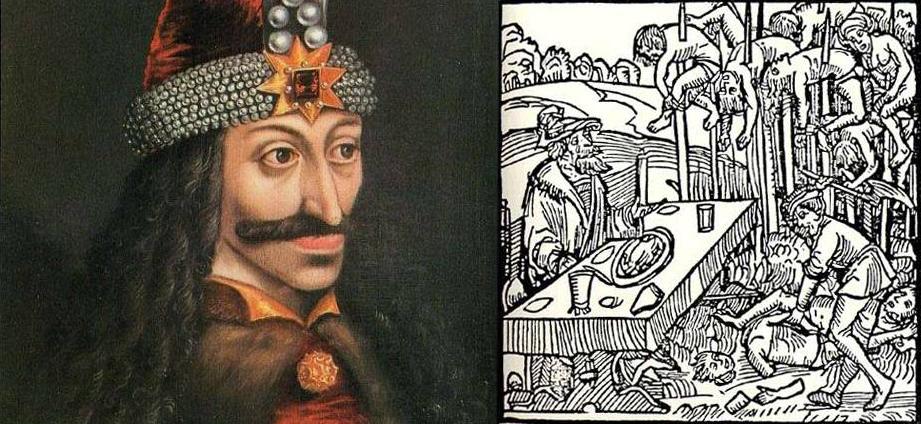
Meet Count Vlad of the Order of The Dragon: The man on whom the legend of Dracula is based.


dracula-vlad-the-impaler


‘Dracula’s tomb’ discovered in Italy


Esma ÇAKIR – ROME / Do?an News Agency


Estonian researchers believe they may have finally discovered the whereabouts of “Dracula’s” grave, which is in Italy and not the Romanian Transylvanian Alps as first thought.


The inspiration behind Bram Stoker’s 1897 gothic novel “Dracula” is thought to be Vlad III, the 15th century Prince of Wallachia in Eastern Europe. Known posthumously as Vlad the Impaler, the ruler was known for his brand of cruelty across Europe, which included impaling his enemies.


Vlad’s ultimate enemy were the Ottomans. Depictions of his endless cruelty made history books, securing his reputation as one of the biggest villains in Turkey’s collective consciousness, as written by Emrah Güler of the Hürriyet Daily News in 2012. Vlad’s story was also converted into a ballet last year in Turkey.


Born in 1431, Count Vlad Tepes was part of a noble family who belonged to the Order of the Dragon, a group that was founded as a means of protecting Christianity in Eastern Europe from Ottoman expansion. His father was nicknamed Dracul, meaning “Dragon,” so the young Vlad became known as Dracula, or “son of Dragon.”…


For the rest, click here.

Share

« Previous PageNext Page »