Re-examining ‘the Elephant Man’

A mysterious man, a lonely and suffering man, a man who captured our minds and hearts….


Re-examining ‘the Elephant Man’

(The Public Domain Review)


Nadja Durbach questions the extent to which Joseph Merrick, known as the Elephant Man, was exploited during his time in a Victorian ‘freakshow’, and asks if it wasn’t perhaps the medical establishment, often seen as his saviour, who really took advantage of Merrick and his condition.
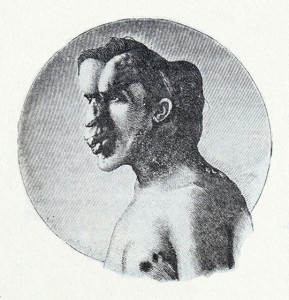
 

Image of Joseph Merrick published in the British Medical Journal in 1886

Image of Joseph Merrick published in the British Medical Journal in 1886


“The scenes are among the most heartless in cinema history: a drunken, abusive showman exhibiting the severely deformed Joseph Merrick to horrified punters. David Lynch’s The Elephant Man begins with its lead character being treated little better than an animal in a cage. But it soon finds a clean-cut hero in the ambitious young surgeon Frederick Treves, who rescues the hapless Merrick from his keeper and gives him permanent shelter at the London Hospital. Supported by charitable donations, the victim recovers his humanity: he learns to speak again (in a decidedly middle-class accent), to entertain society guests and to dress and behave like a well-heeled young dandy. Merrick, no more the degraded show freak, reveals his inner goodness and spirituality and dies happy.


Lynch’s movie is based largely on Treves’ sentimental chronicle. But that narrative is merely one version of events – and one that in the end tells us more about middle-class morality than it does about Merrick. There is another story that casts a different light on what happened…


Read the rest here.

Share

Future Fashions from the 1800’s

Eye candy…


13697996165_e33f35b360_b


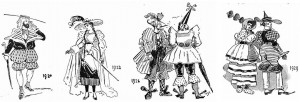
Fashions of the Future as Imagined in 1893
(Public Domain Review)


“Illustrations from a delightful piece called the “Future Dictates of Fashion” by W. Cade Gall and published in the January 1893 issue of The Strand magazine. On the premise that a book from a hundred years in the future (published in 1993) called The Past Dictates of Fashion has been inexplicably found in a library, the article proceeds to divulge this book’s contents – namely, a look back at the last century of fashion, which, of course, for the reader in 1893, would be looking forward across the next hundred years into the future. In this imagined future, fashion has become a much respected science (studied in University from the 1950s onwards) and is seen to be “governed by immutable laws”.


The designs themselves have a somewhat unaccountable leaning toward the medieval, or as John Ptak astutely notes, “a weird alien/Buck Rogers/Dr. Seuss/Wizard of Oz quality” to them. If indeed this was a genuine attempt by the author Gall to imagine what the future of fashion might look like, it’s fascinating to see how far off the mark he was, proving yet again how difficult it is to predict future aesthetics. It is also fascinating to see how Gall envisaged the progression of fashions across the decades – considering that, from our perspective now, his vision of 1970 doesn’t much look much different to 1920 – and to see which aspects of his present he wasn’t even able to consider losing to the march of time (e.g. the long length of women’s skirts and the seemingly ubiquitous frill). As is often the case when we come into contact with historic attempts to predict a future which for us is now past, it is like glimpsing into another possible world, a parallel universe that could have been (or which, perhaps, did indeed play out “somewhere”).


(You can read a full transcript of the very entertaining read here at Forgotten Futures or in its original context here on Internet Archive)”


See the rest here.

Share

Stone Age “skull-smashing” culture: Fear of zombies?

Evidence of a fear of zombies in the ancient world? Perhaps the zombie craze comes from somewhere very old inside our brains, a primal fear…


The zombie apocalypse may be much more than a plot device exploited by modern horror movies. In fact, fears about the walking dead may go back all the way to the Stone Age.

The zombie apocalypse may be much more than a plot device exploited by modern horror movies. In fact, fears about the walking dead may go back all the way to the Stone Age.


Stone Age people may have battled against a zombie apocalypse


Discovery of skulls with their faces smashed in posthumously suggests Neolithic people believed the dead posed a threat to the living.


By: Bryan Nelson


“Archaeologists working in Europe and the Middle East have recently unearthed evidence of a mysterious Stone Age “skull-smashing” culture, according to New Scientist. Human skulls buried underneath an ancient settlement in Syria were found detached from their bodies with their faces smashed in. Eerily, it appears that the skulls were exhumed and detached from their bodies several years after originally being buried. It was then that they were smashed in and reburied separate from their bodies.


According to Juan José Ibañez of the Spanish National Research Council in Barcelona, the finding could suggest that these Stone Age “skull-smashers” believed the living were under some kind of threat from the dead. Perhaps they believed that the only way of protecting themselves was to smash in the corpses’ faces, detach their heads and rebury them apart from their bodies.


But here’s the creepy thing: many of the 10,000-year-old skulls appear to have been separated from their spines long after their bodies had already begun to decompose. Why would this skull-smashing ritual be performed so long after individuals had died? Did they only pose a threat to the living long after their original burial and death?…”


For the complete article click here.


Share

« Previous PageNext Page »