The terrifying Great Norway Serpent…


…a legacy of sea monsters.


Olaus Magnus’s Sea Serpent (The Public Domain Review)


The terrifying Great Norway Serpent, or Sea Orm, is the most famous of the many influential sea monsters depicted and described by 16th-century ecclesiastic, cartographer, and historian Olaus Magnus. Joseph Nigg, author of Sea Monsters, explores the iconic and literary legacy of the controversial serpent from its beginnings in the medieval imagination to modern cryptozoology.
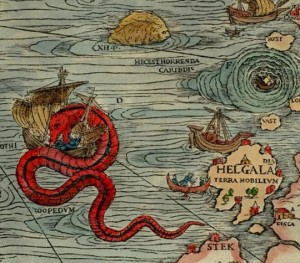
 

The original Sea Orm. Detail from Magnus’s Carta Marina of 1539 showing a bright red monster encircling a ship off the coast of Norway with maelstrom whirling away to the right – Source.

The original Sea Orm. Detail from Magnus’s Carta Marina of 1539 showing a bright red monster encircling a ship off the coast of Norway with maelstrom whirling away to the right.


“In his comprehensive study, The Great Sea-Serpent: An Historical and Critical Treatise (1892), Dutch zoologist Antoon Cornelius Oudemans lists more than three hundred references to the notorious sea monster in his chronological “Literature on the Subject.” The first ten of those, 1555-1665, cites Olaus Magnus’s sea serpent: editions of Olaus’s Historia de gentibus septentrionalibus (“History of the Northern Peoples”) and natural histories of Conrad Gesner, Ulisse Aldrovandi, Edward Topsell, and John Jonston. The list establishes Olaus’s serpentine monster as the major ancestral source of sea serpent lore from the sixteenth century to widespread sightings of such creatures in Oudemans’s own time. It is the basis for illustration and discussion of the creature in marine studies and popular fantasy up to the present, five hundred years after Olaus created it…


Read more here.

Share

Ancient Petra: Sanctified by the sky

Petra is a place that lures the imagination – we cannot help but travel there in our fantasies…


A new statistical analysis published in the Nexus Network Journal reveals something new about these glorious structures…


Photograph by Katherine Kiviat, Redux


Ancient City of Petra Built to Align With the Sun

The Nabatean culture erected the city to highlight solstices, equinoxes.


by Christine Dell’Amore (National Geographic)


“An ancient civilization built the famous, stone-hewn city of Petra so that the sun would illuminate their sacred places like celestial spotlights, a new study says.


Petra, a giant metropolis of tombs, monuments, and other elaborate religious structures carved into stone cliffs, was the capital of the Nabatean kingdom, a little-understood Middle Eastern culture that ruled much of modern-day Jordan from the third century B.C. until the first century A.D.


These wealthy spice traders worshiped the sun, among other deities, and may have given importance to the equinoxes, solstices, and other astronomical events that are determined by how the sun moves across the sky. (Also see: “‘Lost City’ of Petra Still Has Secrets to Reveal.”)…”


For the rest, click here to go to National Geographic.

Share

Lost Libraries: Are We Burning The Library at Alexandria Every Single Day?

Welcome to the digital age – where people are tossing their book collections in the garbage, keeping their precious family photos on hard drives, and storing all of their music in the “cloud”. We are presently dooming ourselves to a ‘digital dark age’ of such immense and tragic proportions that the burning of the Library at Alexandria is a trifle in comparison. Perhaps you’ve noticed that the floppy disks you used just a few years ago are no longer usable? All of those files, lost. Digital media itself may endure the years, but the players with which you access that media changes with the wind…


Are you panicking yet?


Perhaps we need to take on the “Renaissance preoccupation” with lost intellectual treasures?


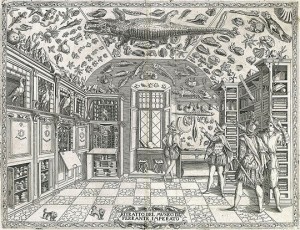
Engraving from the Dell'Historia Naturale (1599) showing Naples apothecary Ferrante Imperato's cabinet of curiosities, the first pictorial representation of such a collection

Engraving from the Dell’Historia Naturale (1599) showing Naples apothecary Ferrante Imperato’s cabinet of curiosities, the first pictorial representation of such a collection


LOST LIBRARIES


…”In the latter half of the 17th century the English polymath Thomas Browne wrote Musaeum Clausum, an imagined inventory of ‘remarkable books, antiquities, pictures and rarities of several kinds, scarce or never seen by any man now living’. Claire Preston explores Browne’s extraordinary catalogue amid the wider context of a Renaissance preoccupation with lost intellectual treasures…”


See more here at the Public Domain Review.


Share

« Previous PageNext Page »