From the archive for alchemy: Robert Fludd and His Images of The Divine

These intricate and inspired engravings speak for themselves, but the background behind them is equally fascinating… Enjoy!
 

6130074253_c153f55089_o


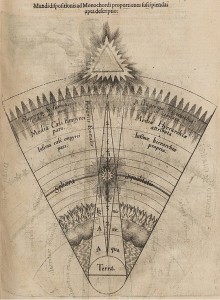
“Between 1617 and 1621 the English physician and polymath Robert Fludd published his masterwork Utriusque Cosmi, a book split into two volumes and packed with over 60 intricate engravings. Urszula Szulakowska explores the philosophical and theological ideas behind the extraordinary images found in the second part of the work.


Robert Fludd was a respected English physician (of Welsh origins) employed at the court of King James I of England. He was a prolific writer of vast, multi-volume encyclopaedias in which he discussed a universal range of topics from magical practices such as alchemy, astrology, kabbalism and fortune-telling, to radical theological thinking concerning the inter-relation of God with the natural and human worlds. However, he also proudly displayed his grasp of practical knowledge, such as mechanics, architecture, military fortifications, armaments, military manoeuvres, hydrology, musical theory and musical instruments, mathematics, geometry, optics and the art of drawing, as well as chemistry and medicine. Fludd used the common metaphor for the arts as being the “ape of Nature,” a microcosmic form of the manner in which the universe itself functioned.


Fludd’s most famous work is the History of the Two Worlds (Utriusque Cosmi … Historia, 1617-21) published in five volumes by Theodore de Bry in Oppenheim. The two worlds under discussion are those of the Microcosm of human life on earth and the Macrocosm of the universe (which included the spiritual realm of the Divine)…”


See the images here, and read more about them.


Search the archive for alchemy, here.


Share
Hawking’s Story of Everything

We hope that you are having a wonderful start to the new year. Please enjoy a little summary of our universe – perhaps it will help you put things into perspective as you endeavor to wrangle 2014!


“The Story of Everything: In two mind-blowing hours, Hawking reveals the wonders of the cosmos to a new generation. Delve into the mind of the world’s most famous living scientist and reveal the splendor and majesty of the universe as never seen before. See how the universe began, how it creates stars, black holes and life — and how everything will end….”


(From Knowledgeoftheday.org)

Stephen Hawking’s Universe – The Story of Everything (2010) from Luis Ribeiro on Vimeo.

Share

The Incans and the Egyptians: Connected through time and space?

HAPPY NEW YEAR FROM THE MUSEUM OF MYSTERIES!


And now for some more mysteries…


From gold funeral masks, nearly identical religions, obelisks with hieroglyphics, and so much more, the astounding similarities of the Incan/pre-Incan and Ancient Egyptian cultures is not to be denied. How did two cultures separated in antiquity by a vast ocean co-evolve in so many inexplicable ways? The following article delves into a huge list of coincidences that will no doubt stun you while also convincing you that there simply had to be some sort of connection between these cultures. Was there a seafaring global mother culture such as Atlantis that informed the customs, architecture, and religions of both the Incans and the Egyptians?


Egyptian-Inca-animal-necklaces


The Mystery Of Twin Cultures On Opposite Sides Of The Atlantic


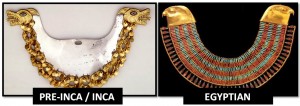
“The ancient Egyptians (in Africa) and the ancient pre-Incas/Incas (in South America) evolved on opposite sides of the globe and were never in contact; yet both cultures mysteriously possessed the same strikingly identical body of ancient art, architecture, symbolism, mythology and religion. The Victorian-era scholars, faced with this enigma, concluded that both cultures must have been children of the same Golden Age parent civilization, “Atlantis.” Today, Egyptian/Inca parallels are not only being ignored by American and Western scholars, they’re being suppressed.


Many baffling and unsolved similarities link the ancient Egyptians and the ancient pre-Incas/Incas – even though both cultures evolved on opposite sides of the planet, separated by oceans.


Victorian-era scholars, faced with this enigma, believed both cultures inherited the same high wisdom from the same exceedingly older source—a shared “parent civilization” now lost to history. For the Victorians this common parent hypothesis explained the parallels well. These Victorian scholars called this common parent “Atlantis,” following Plato and the Classical historians…”


For the rest, click here.


Share

« Previous PageNext Page »