Playing with the dead

A playground in the middle of a cemetery. At first glance it would seem out of sorts, morbid and creepy, right? But if you think about it, the idea of having a playground in a cemetery is a celebration of life – a connection between life and death that is so often missing in our culture.

Enjoy this thoughtful piece by Uwe Hook:

The constant battle to think outside of accepted norms

I went to the Yanaka Cemetery this morning to explore the resting place of the last shogun. The cemetery is in the middle of a lovely neighborhood, almost untouched by World War II. While wandering around I discovered this.

IMG_2346

A playground in the middle of a cemetery. I had look twice to believe my eyes: Indeed, a playground smack-dab in the middle of a cemetery. I don’t know the Japanese culture well enough to understand the reason behind this placement but it hit me immediately: What a great idea. What a brilliant way to connect life and death. What an easy way to make your pilgrimage to visit your dead loved ones an enjoyable experience for your kids. What an innovative way to make grieving part of our human experience, not something we want to box up nicely and put away…

For the complete piece please click here.

Share
Sorry To Tell You This, But The Apocalypse Will Be Postponed…

Oh dear. We’re going to have to reschedule all those apocalypse parties we’ve been planning for December 2012! (No, this is not a Halloween prank folks, but, we do wish you a fantastic Halloween!)

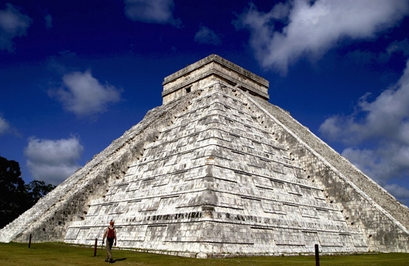
The Kukulkan pyramid stands at the Mayan ruins of Chichen Itza in Mexico’s Yucatan peninsula


By Stephanie Pappas, livescience.com/Senior Writer

It’s a good news/bad news situation for believers in the 2012 Mayan apocalypse. The good news is that the Mayan “Long Count” calendar may not end on Dec. 21, 2012 (and, by extension, the world may not end along with it). The bad news for prophecy believers? If the calendar doesn’t end in December 2012, no one knows when it actually will – or if it has already.

A new critique, published as a chapter in the new textbook “Calendars and Years II: Astronomy and Time in the Ancient and Medieval World” (Oxbow Books, 2010), argues that the accepted conversions of dates from Mayan to the modern calendar may be off by as much as 50 or 100 years. That would throw the supposed and overhyped 2012 apocalypse off by decades and cast into doubt the dates of historical Mayan events. (The doomsday worries are based on the fact that the Mayan calendar ends in 2012, much as our year ends on Dec. 31.)…

For the complete story, click here.


Share

Is consciousness a fundamental quality of the cosmos?

When thinking about how reincarnation may work, it can help to consider the idea of nonduality, how, perhaps, all consciousness is related, and therefore all consciousness is One.

Is consciousness itself a fundamental quality of the cosmos?…

“Physics shows that when we look at matter it is mostly empty space. We therefore observe this nothingness and it is our mind that gives it the appearance of solidity…Maybe it is not a nonduality of matter but a nonduality of consciousness we should explore.

The new hard question is not how brain gives rise to consciousness but how do our minds take on all the different forms that we experience as reality?

The nondual perspective to this question is that all is one, there is no difference between form and emptiness, mind and matter.

Could this nondual prospective heal the split between science and spirituality?”

Please enjoy this talk by Peter Russell, a fellow of the Institute of Noetic Sciences. To find more about him please visit his website The Spirit of Now.


Share

« Previous PageNext Page »