Total (dream) Recall

Scientists postulate that humans dream every night, and likely are dreaming all night long….


That’s a lot of information to remember and store. Is there a way to control what we remember?

 

content_castleintheclouds_dreamrecallinset


The Tricky Science of Remembering Dreams

By Chelsea Harvey


“You wake in the early hours of the morning with your heart beating fast and the unsettling sense that you’ve just emerged from a strange dream —  but what was it? Vague images swim through your mind, faces you only half-recognize, and for a second you think it’s all coming back to you. Then you blink, and the memory is gone.


The subject of dream recall — that is, how and when and to what extent we remember our dreams — is a tricky topic, and one that’s fascinated researchers for decades. Why do we remember our dreams some nights, but not others? Why do some people seem to remember their dreams more often than others? We don’t have all the answers, but we know that our ability to remember our dreams in the morning most likely involves a complex set of factors including how we wake up, what our personalities are like and what happens inside our brains while we sleep.


The Critical Waking Period
The first thing to keep in mind is that you most certainly dream, even if you don’t remember doing it. Scientists generally believe that humans dream every night — and, probably, all night long.


“In every sleep stage, there’s some kind of subjective experience,” said Michael Schredl, a researcher in the sleep laboratory at the Central Institute of Mental Health in Mannheim, Germany, and an expert on dream recall. Researchers widely agree that the reveries experienced during REM sleep are generally more intense, he said, but some type of dreaming is likely present in all stages…”


For the rest, click here.

Share
The Origin of the Myth of Excalibur?

Myth or memory?


From Atlas Obscura,


screen-shot-2016-09-07-at-4-01-47-pm


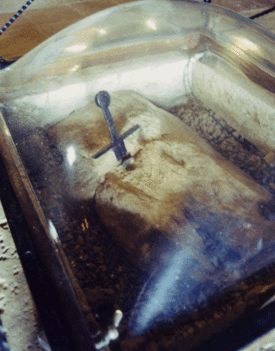
…The legendary sword in the stone from the lore of King Arthur does exist. But it’s not in Avalon. It’s in Italy — on display in the Montesiepi Chapel in Tuscany.


The Sword in the Stone at Montesiepi Chapel


The real sword in the stone is found not in England, but in an Italian chapel.


“Galgano Guidotti was born in 1148 near Chiusdino. After spending his youth as a wealthy knight, in 1180 Giudotti decided to follow the words of Jesus and retired as a hermit near his hometown. He began to experience visions of the Archangel Michael, leading him to God and the twelve apostles on the hill of Monte Siepi. In one vision, Michael told Giudotti to renounce all of his earthly possessions. He responded that this would be as difficult as splitting a stone, and to prove his point, thrust his sword into a rock. To his surprise, the sword went through the impenetrable surface as though it was water. Shortly after, an errant horse led Giudotti to the very hilltop that had appeared in his visions, where he was moved to plant a cross. Not having any wood handy, he plunged his sword into a rock, just as he had in the vision, where it was embedded for all time. One year later Giudotti died, and in 1185 Pope Lucius the 3rd declared him a saint, and the Montesiepi Chapel was built up around it.


While the sword was considered a fake for years, recent studies examined the sword and the hands, and the dating results as well as metal and style of the sword all are consistent with the late 1100s – early 1200s. This may mean that the story of Excalibur in the stone originated with Guidotti in Italy….”


For the rest, click here.

Share

Still lives of meals from scenes in literature…

Ah! These make for a most fantastic guessing game!


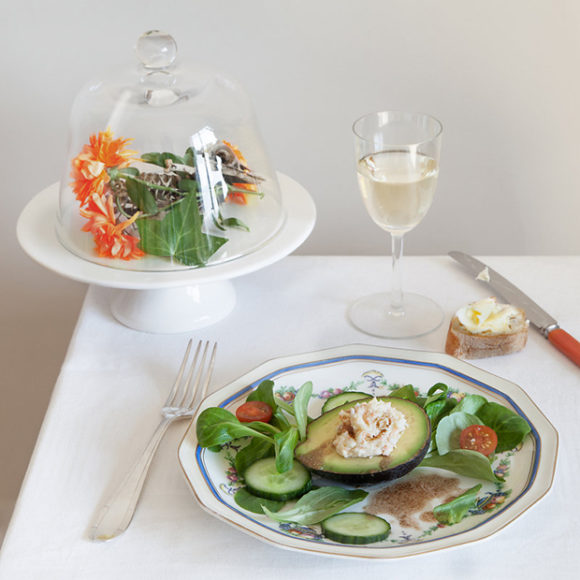
From which book does this meal hail? (Clue in the caption)–


From 'Fictitious Feasts', work about food scenes in literature. Here the memory of the avocado crabmeat salad, with the bell jar, symbol of death and despair, from the American novel"The Bell Jar" by Sylvia Plath.

From ‘Fictitious Feasts’, work about food scenes in literature. Here the memory of the avocado crabmeat salad, with the bell jar, symbol of death and despair, from the American novel…


From Featureshoot.com,


Spellbinding Photos of Meals from Classic Books
by Ellyn Kail


“Paris photographer Charles Roux describes his boyhood self as “a lonely kid that filled his life – and his voids- with literary fiction.” In this way, you could say Fictitious Feasts began in the artist’s early years, when he was curled up with a book, turning the pages and imagining the worlds inside them.


Growing up, he always had a vivid and visceral picture in his head of Alice’s tea party in Wonderland, the dinner table at the Ramsay house in Virginia Woolf’s To the Lighthouse, Gregor Samsa’s wretched pile of rotting food, left on the floor each morning by his sister Grete in Kafka’s The Metamorphosis. As an adult and still life photographer, he had the means to bring these scenes to life.


Food, Roux suggests, has a hallowed place in the literary realm. Meals become metaphors; the real magic is in the mundane. For Fictitious Feasts, the photographer started with the books. Some, like the madeleines from Remembrance of Things Past and the porridge stolen by Goldilocks from the Three Bears, popped into his head instantly. Others took more time to recall and dig up. He read and reread the classics, jotted down notes, and sketched out table settings…”


For the rest, click here.

Share

« Previous PageNext Page »