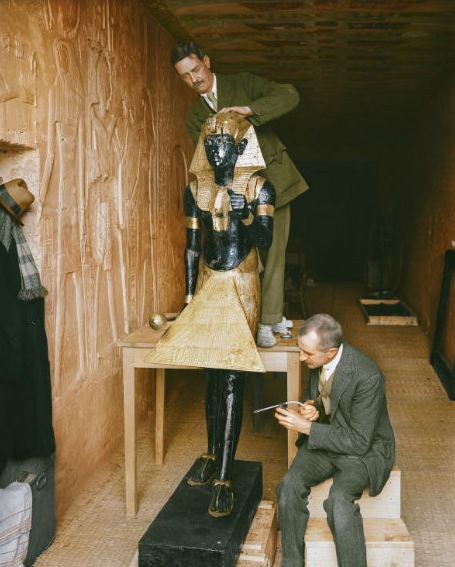
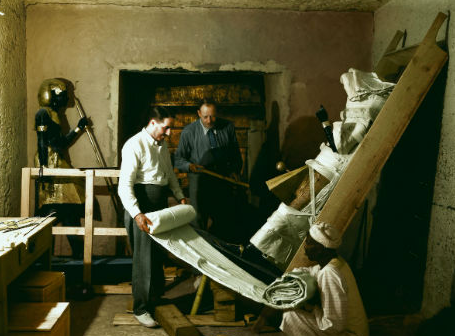
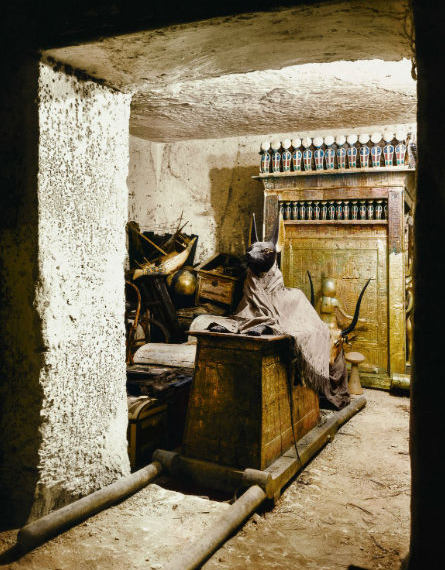
Behold: King Tut’s excavation, full color, 1922

These photographs speak for themselves…


King Tut’s excavation, in color (1922)


From Dangerous Minds,


“You’ve probably seen these photos of Tutankhamun’s excavation a million times already. But, whether you saw them in school, National Geographic magazine, books or on TV, they’ve always been in B&W. Well, some of the more iconic images from the discovery have been colorized by Dynamichrome for the exhibition The Discovery of King Tut which opens in New York City at Premier Exhibitions on November 21, 2015.


I’m normally not a fan of colorized photos, but these are different for some reason. They’re almost like Dorothy leaving her B&W Kansas and stepping into Oz for the first time or the doors opening up to Willy Wonka’s chocolate factory. Glorious eye candy…”


Screen Shot 2015-12-11 at 2.57.47 PM Screen Shot 2015-12-11 at 2.57.56 PM Screen Shot 2015-12-11 at 2.58.06 PM


Click here for the rest of the gallery.


Share

Cotard’s delusion: When you think you are the walking dead

It’s December. We all feel a little nutty this time of year. But not all of us experience real actual psychosis, and even fewer of us will ever experience the particular psychosis known as “Cotard’s delusion” — in which the patient believes that she is dead.
 

Screen Shot 2015-12-07 at 7.53.44 PM


From The Toast,


Perdition Days: On Experiencing Psychosis

By Esmé Weijun Wang


“Let’s note that I write this while experiencing psychosis, and that much of this has been written during a strain of psychosis known as Cotard’s delusion, in which the patient believes that she is dead. What the writer’s confused state means to either of us is not beside the point, because it is the point. The point is that I am in here, somewhere: cogito ergo sum.


*


In October 2013 I attended a speakers’ training at the Mental Health Association of San Francisco. As a new hire at the bureau, I would begin, in 2014, to deliver anti-stigma talks for schools, government agencies, and other organizations around the city. Part of this training included a lesson on appropriate language use — to say, “person with bipolar disorder,” or “person living with bipolar disorder,” or “person with a diagnosis of bipolar disorder,” instead of “bipolar” as predicate adjective. We speakers were told that we are not our disease, our diseases. We are instead individuals with disorders and malfunctions. Our conditions lie over us like smallpox blankets; we are one thing, and the illness is another, just as a person with cancer is not a “cancer” herself, but a person who has had, through misfortune, a condition at the cellular level.
This hypothetical person with cancer is still the same person. This person with cancer will die or go into remission or be cured of the unwanted guest.


Of course, the unwanted guests are her own cells.


I had endured the longest period of psychosis of my life earlier that year, from February through August, and after trying every atypical, i.e. new-generation, antipsychotic on the market, I began taking Haldol, a vintage antipsychotic, which cleared my delusions until November 4th. On that morning, I looked at the antique sewing table in my office, seeing red wood without seeing it, and felt the old anxiety of unreality. The full delusion would not come until a day later, but I knew what this meant; to look at the table and suddenly realize that the past few weeks were not simply feeling “scattered,” as I repeatedly told others, but were pre-psychosis signals and warnings.


Such signals seem ordinary to other people, and were ordinary to myself…”


For the rest, click here.


Share
Who Was The Daughter of the ‘Mad Monk’?

A peek into history…


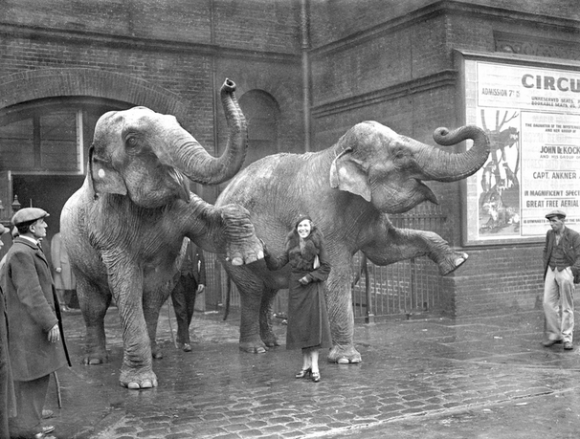
Maria Rasputin as an animal trainer at a London circus in 1934. (Photo: Planet News Archive/Getty Images)

Maria Rasputin as an animal trainer at a London circus in 1934. (Photo: Planet News Archive/Getty Images)


The Many Lives of Maria Rasputin, Daughter of the ‘Mad Monk’

by Hadley Meares (Atlas Obscura)


“I was born in 1899 in the village of Pokrovskoe in the county of Tobolsk. My parents are peasants, simple people. Our family consists of: father, mother, grandfather (my father’s father), my brother, sister and myself. We all live happily together but sometimes I get cross with my brother and sister, but with my sister I get cross all the time. My father plays an important role because the Sovereign knows him and loves him.”


“Maria Grigorievna Rasputin wrote the simple words above as a young teenager in unpublished diaries. But from the beginning of her life in rural Siberia to its end in sunny Los Angeles, nothing about Maria’s life would ever be simple or easy.


Maria spent her early childhood in a relatively well-off family of peasants. Her mother was a practical, hardworking woman. Her father Grigori, was a Starets, an un-ordained holy man who traveled the country preaching and comforting those in need. From the start, Maria seems to have had a healthy sense of skepticism. She and her brother and sister dreaded the long hours of enforced prayer and fasting “for which everything, anniversaries or penitence’s, served as an excuse.”


In 1906, the family’s life was transformed when Grigori, who would become known to history simply as “Rasputin,” was introduced to the royal family in St. Petersburg. He was soon credited by the Empress Alexandra for saving the life of Alexi, the hemophiliac heir to the Russian throne. In 1910, Maria and her sister, Varvara, were sent to live with their father in St. Petersburg so that they could be transformed into “little ladies.”…


For the rest, click here.


Share

« Previous PageNext Page »