The Power Of The Witch

Shazam!

Happy October!
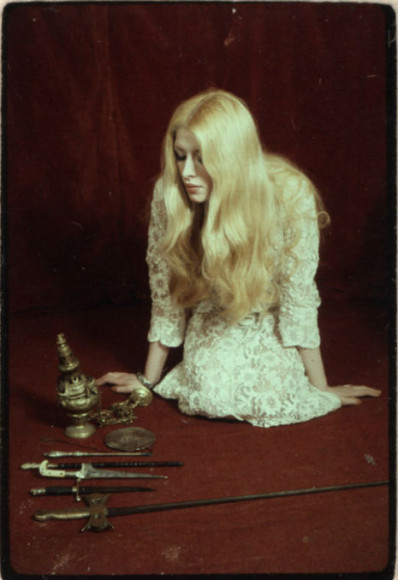
 

Maxine_Sanders


‘The Power Of The Witch’ – super rare British witchcraft documentary from 1971


“What a find! The Power Of The Witch is a documentary about witchcraft as it was practised in the late 60s and early 70s in the UK – apparently it was only screened once and there is practically no information about it on the web. From the uploader taitsitarot‘s YouTube description:


An extremely rare documentary about Witchcraft aired once in the UK in 1971. Featuring contributions from Eleanor Bone, Cecil Williamson, Alex & Maxine Sanders [above], Doreen Valiente et al. Very much of its time and with some very rare footage, also includes reference to the famously unsolved murder of Charles Walton on Meon Hill.

The Power Of The Witch is worth a watch even if you are not particularly interested in the occult – rather watch it as a document of its time, capturing as it does people’s attitudes, beliefs, fashions and plummy Brit accents. It’s a curious mixture of patriarchal stiff upper lip-ism and unerring belief in both Christianity and the forces of magic, making it feel very much as if it comes from a completely different era. Not to mention, it’s a goldmine of potential witch haus footage:…”


For the rest of the article, click here.


To watch the film, click here.


Share
The Fairy Faith

A scholarly piece on the origin and meanings of a faith we know and love…


Screen Shot 2015-09-27 at 10.16.59 PM


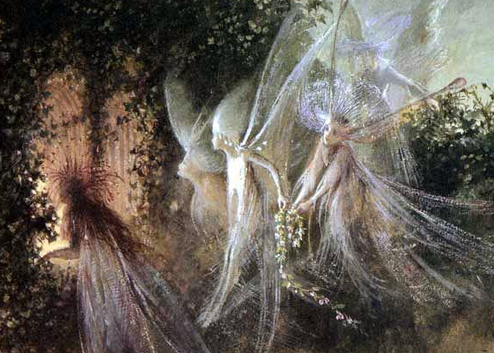
The Fairy Faith: An ancient indigenous European Religion
By Carolyn Emerick


“There are two different meanings to the term “Fairy Faith.” On one hand, it simply refers to the old folkloric belief in fairies, and the practices found therein.  This meaning is usually ascribed to the modern Celtic nations of Ireland and Scotland, where belief in fairies lingered long into the modern era. In this sense, it is analogous to other places where belief in fairy-like creatures continued even into the present day, such as in Iceland and even in some Native American or Canadian First Nations traditions.


The second meaning is found in the modern neo-pagan community. It seems that the neo-pagan Fairy Faith sprung from the Wiccan community somewhere around the 1970s in California. As the modern pagan movement proliferated, many different paths developed. Some were divergent variants branching off of Wicca, while others were born in the reconstructionist movement (reconstructionist meaning attempts to reconstruct the ancient indigenous religions of Europe, the Mediterranean, and elsewhere, with historical accuracy). Yet more versions of neo-pagan paths emerged that were influenced by these, but took their own shape and form. So in the modern pagan community, the Fairy Faith has various incarnations and meanings. This article will focus mainly on the first definition, but will touch lightly on the second.


Origins of Fairy Belief
The modern notion of fairy vastly different from that which our ancestors knew, and even antiquated descriptions vary widely. While it’s fair to say that the image of the fairy has changed a number of times, it’s origins sprang from the murky haze of the Neolithic period…”


For the rest, click here.

Share

Into The Woods


Forest, to paper, to forest again…


Screen Shot 2015-09-27 at 9.47.54 PM


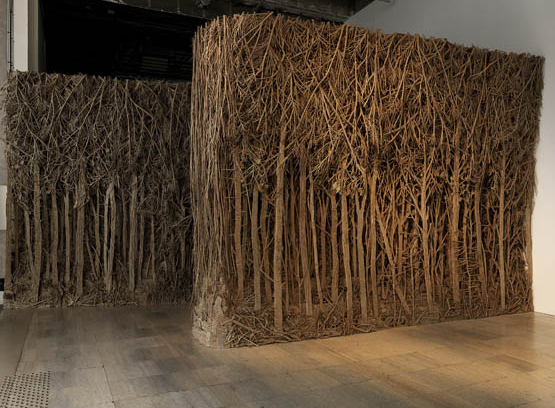
Layer Upon Layer: Eva Jospin Sculpts Cardboard Into Dense, Mysterious Forests (Beautiful / Decay)


“Sculptor Eva Jospin constantly reinvents the idea of what a forest is over and over again. She cuts, layers, arranges, glues and builds cardboard into different interpretations of The Woods. Her pieces range from smaller 2D pictures compiled from dense sticks, branches and flaky bits of wood, to life size 3D installations that you are invited into, and can move around within. For Jospin, cardboard is just the medium for a larger message; these trees express many things:


The forest – an incarnation of nature in the wild – is above all the setting in traditional storytelling of tests of courage, and can be a gloomy or initiatory place. The forest is also where one encounters oneself. This walk through the forest initiates the visit to ‘ Inside’, which is also an inner journey. (Source)

Jospin uses a material that is not only durable, robust, strong, and supportive, but also fragile, impermanent, raw and insubstantial. She plays on these two points of view – they mirror the actual qualities of trees, nature and our relationship to it. These poetic attachments to Josie’s Forest pieces isn’t lost on her critics either…”


For the rest and more delicious photos of these pieces, click here.

Share

« Previous PageNext Page »