What is ‘Sleep’ in One Sentence Or Less

A worthy challenge isn’t it? What IS sleep? And can you describe it in one sentence?…


lonerwolf.com

www.lonerwolf.com


From Van Winkles,
23 Experts Try to Explain ‘Sleep’ in One Sentence Or Less
By Theresa Fisher


“Sleep is a mystery.


Scientists acknowledge certain objective features of sleep, but, beyond that, differ in what they see as its essential elements. In defining it, would they emphasize the biological nature of the activity, its purpose or its benefits? Would “sleep” encompass those squishy states of semi-consciousness between sleeping and wakefulness? What about alcohol black-outs and comas, or when you zone out during slide 51 of a coworker’s scintillating presentation on growth tactics? And we haven’t even broached the philosophical side of things.


So we asked a variety of experts to answer the question “What is sleep?” in one sentence or less. Some definitions are specific to certain functions; others are wonderfully vague. All of them offer perspective on the universal act of rest.


1. “Sleep is the nightlife of the brain that functions to sustain and nourish our waking lives.”

— John Peever, Professor Professor of Cell and Systems Biology, University of Toronto


2. “Sleep is a fascinating scientific mystery — and a great personal blessing.”

— Hank Greely, Professor of Law and Genetics, Stanford University


3. “The promise that never stops promising.”

—RM Vaughan, Essayist


4. “Having your brain almost completely disconnected from the outside world but still living an internal life singular to you, while your body rests, lying down.”

— Célyne Bastien, Psychologist, Laval University, Québec, Canada…”


For the rest, click here.


Share
The tale of the tsunami ghosts…

A ghost story from a faraway land.


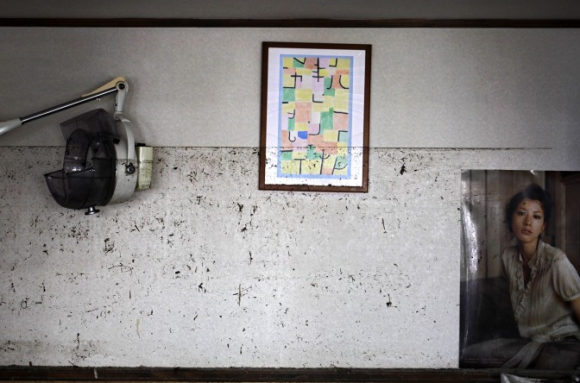
The waterline from the March 11 tsunami is left on the wall at the barber shop in Ishinomaki, Miyagi Prefecture, northeastern Japan on April 16, 2011. (AP Photo/Sergey Ponomarev)

The waterline from the March 11 tsunami is left on the wall at the barber shop in Ishinomaki, Miyagi Prefecture, northeastern Japan on April 16, 2011. (AP Photo/Sergey Ponomarev)


Taxi Drivers Say They’ve Picked Up Ghosts of 2011 Tsunami Victims in Japan
By Zachary Stieber, Epoch Times


In Beyond Science, Epoch Times explores research and accounts related to phenomena and theories that challenge our current knowledge. We delve into ideas that stimulate the imagination and open up new possibilities. Share your thoughts with us on these sometimes controversial topics in the comments section below.


“Taxi drivers in Japan say they’ve picked up ghosts of victims of the 2011 tsunami.


At least seven drivers claim passengers have entered their vehicle only to vanish into thin air before they reach their destination.


One driver described a young woman dressed in a coat climbing into his cab near Ishinomaki Station and telling him: “Please go to the Minamihama (district).”


In response, the driver noted that the area was “almost empty,” and asked her if she was sure she wanted to go there, reported the Asahi Shimbun newspaper.


The woman replied in a trembling voice: “Have I died?”


When the driver turned around to look at her, no one was there…”


For the rest, click here.

Share

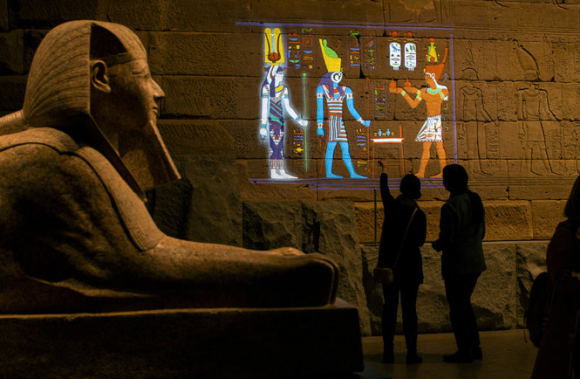
The Temple of Dendur, as originally imagined?

So fascinating! The colors are spellbinding.


MJ posted a link to this show on her Facebook, and wrote:


I can’t wait to see this show at the Met! I ran away from home when I was 8… to the Egyptian wing… it’s been my home way from home ever since. (Don’t worry, it was only 1 block away from where we lived. Only one block to cross.)


Screen Shot 2016-02-07 at 8.49.23 PM


Temple of Dendur’s Lost Colors Brought to Life at the Met
By JOSHUA BARONE


“As depicted in popular culture, ancient Egypt is awash with the color beige. A trip to the Metropolitan Museum of Art would seem to reflect that notion: The Temple of Dendur, with its weatherworn sandstone, could fit in naturally with the earth tones of “Aida” or “The Mummy.”


But Egyptologists know that this temple, like many others of the ancient world, was painted with vivid colors and patterns. In “Color the Temple,” a marriage of research and projection-mapping technology, visitors to the Met can now glimpse what the Temple of Dendur may have looked like in its original, polychromatic form more than 2,000 years ago.


The Met’s MediaLab has installed a projector that fills in the temple’s carvings with color. Through March 19, one section of the structure’s south side is on view: a scene of the Roman emperor Augustus, dressed as a pharaoh and making an offering to the deities Hathor and Horus. Because the sun would wash out the projector’s light (the gallery has floor-to-ceiling windows), the scene is illuminated on Friday and Saturday evenings, when the Met offers extended hours…”


For the rest, click here to go to the NYTimes.

Share

« Previous PageNext Page »